
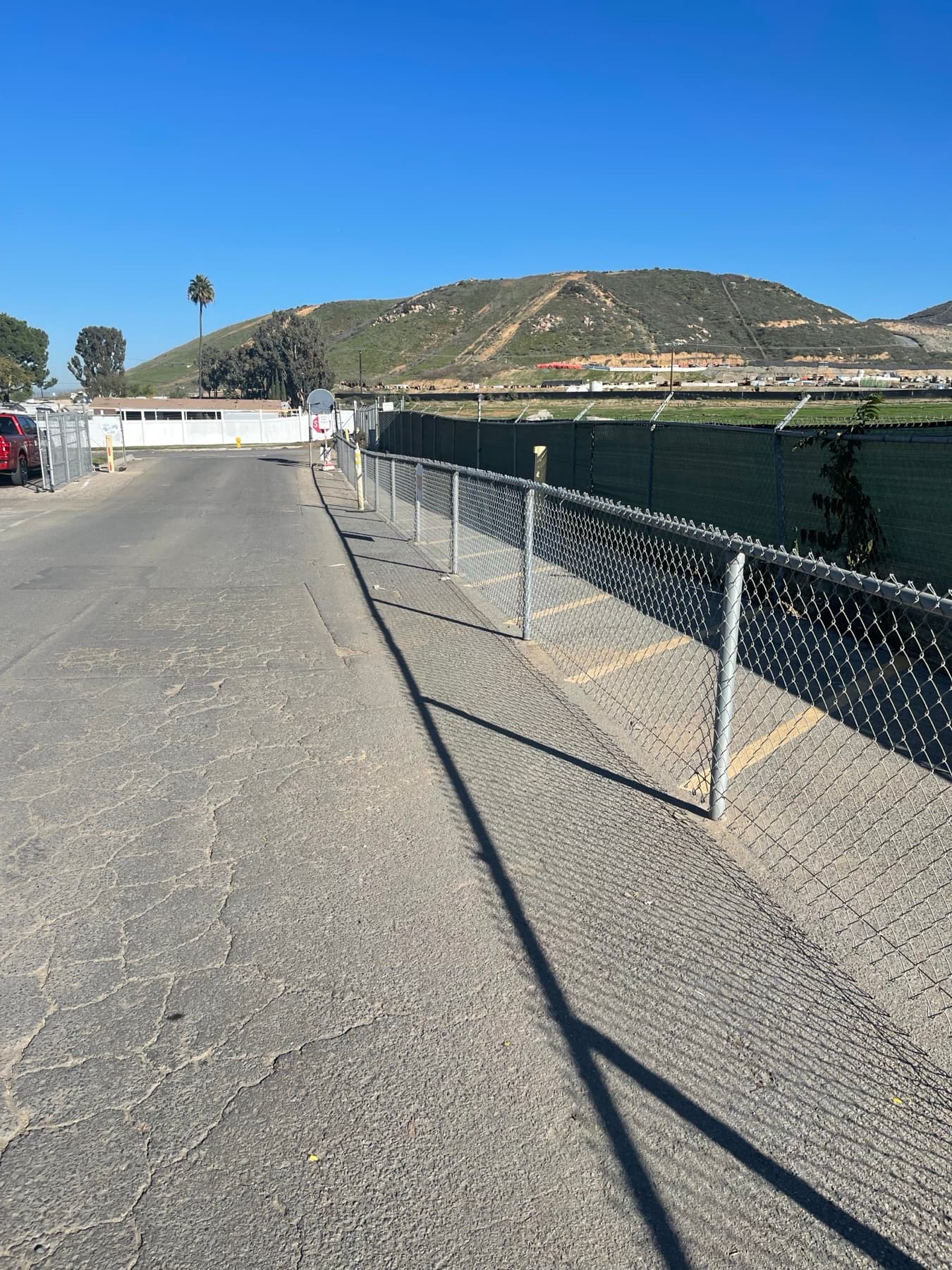
Chain link fencing usually gets described with the same three words: affordable, durable, and practical. All three are true, but they leave out some of the most useful chain link fence benefits.
The open design can preserve sightlines, let air move through a property, work around difficult layouts, simplify certain repairs, and give you more flexibility with gates and access. Those advantages can matter just as much as the initial price.
For a homeowner, that may mean keeping a dog contained without making the backyard feel closed in. For a business, it may mean securing a long perimeter while employees, cameras, and managers can still see what is happening on the other side.
The important question is not whether chain link is the cheapest fence. It is whether its particular strengths solve the problems your property actually has.
Project-Guided by Empire Fence
Practical fencing guidance shaped around the decisions that affect real residential and commercial projects: property lines, gates, access, pets, security, slopes, material choices, repairs, privacy, and installation requirements.
The goal is to help homeowners, property managers, and business owners understand those issues early, avoid expensive planning mistakes, and choose a fence based on how the property will actually be used.
Quick Answer: What Are the Hidden Benefits of a Chain Link Fence?
Some of the most overlooked chain link fence benefits are visibility, airflow, flexible layouts, easier localized repairs, adaptable gate placement, and the ability to add privacy only where it is needed.
Chain link can also make sense when you need to fence a long boundary without creating a visual wall around the property. For businesses, the open mesh can support perimeter monitoring and controlled access. For homes, it can provide containment while keeping the yard open and easy to supervise.
It is not automatically the best fence for privacy or decorative frontage. Its real strength is practical boundary control.
At a Glance: Chain Link Benefits Property Owners Often Overlook
Hidden Benefit / Why It Matters
- Clear sightlines: Helps you see pets, children, vehicles, visitors, and activity beyond the fence.
- Open airflow: Air moves through the mesh instead of meeting a solid wall.
- Preserved light: Gardens and outdoor areas are not shaded by a solid fence panel.
- Localized repairs: Damage may be addressed in the affected area rather than treating the entire fence as lost.
- Flexible layout: Chain link works well around many long, sloped, or irregular boundaries.
- Gate flexibility: Pedestrian, driveway, and service access can be planned into the system.
- Selective privacy: Slats or screening can be added only where visual separation matters.
- Mixed-material potential: Decorative fencing can be used at the front while chain link handles less-visible boundaries.
- Low upkeep over long runs: Maintenance becomes especially important when hundreds of feet of fencing are involved.
These advantages explain why chain link appears in such different settings. The same basic fence can solve problems in a backyard, rental property, warehouse, utility area, storage yard, dog run, or commercial perimeter.
Chain Link Fencing Does More Than Mark a Boundary
Every fence establishes a line. What matters is what happens after that line is installed.
Does the fence make it difficult to see a driveway? Does it block a useful view? Will it need painting or staining? Can employees see through the perimeter? Is there enough room for a vehicle gate? What happens when landscaping equipment damages one section?
That is where chain link becomes more interesting.
A well-planned system gives you a physical boundary without necessarily turning the property edge into a solid wall. That combination creates several advantages property owners often overlook when comparing materials.
A good chain link fence contractor should therefore look at how the property is used before recommending height, gates, coating, mesh, or layout.
1. Clear Sightlines Can Improve Everyday Security
People sometimes assume that better security always means blocking the view. That is not necessarily true.
A solid fence creates visual separation. Chain link creates physical separation while leaving much of the area visible.
That difference can be useful.
For homes: supervision without closing off the yard
Suppose your main goal is keeping a dog inside the backyard.
You may still want to see what the dog is doing from the patio, driveway, or another part of the property. Parents may have similar concerns when children are playing outside.
Chain link lets you establish a boundary without hiding everything behind a solid panel.
It can also make a smaller backyard feel less confined because your eye can continue beyond the fence line.
For businesses: visibility across active areas
Visibility can become even more useful on commercial properties.
Consider a storage yard, equipment area, parking lot, service yard, or warehouse perimeter. Managers may want a secure boundary while still being able to see vehicles, deliveries, employees, visitors, or unusual activity.
Security cameras can also maintain clearer sightlines through an open fence than through a solid privacy wall.
That does not make standard chain link an anti-climb or high-security barrier. It simply means visibility itself can be part of a broader security plan.
2. The Open Mesh Lets Air, Light, and Views Move Through
The openings in chain link mesh do more than provide visibility. They allow air to pass through.
A solid fence catches considerably more wind because it presents a continuous surface. An open fence allows much of that air to move through the boundary instead.
That characteristic can be useful on exposed sections of a property.
It also means chain link does not create the same visual or physical barrier around gardens and landscaped areas.
Sunlight can continue reaching plants near the fence. Air can circulate. Views remain more open.
This is especially useful when the purpose of the fence is containment rather than privacy.
There is one planning detail worth remembering: adding dense privacy screening changes how air moves through the fence. If you add slats or screening, wind exposure should become part of the installation discussion rather than assuming the fence will behave exactly like open mesh.
3. Damage Can Often Be Addressed Without Replacing the Whole Fence
Fence damage does not always happen evenly.
One area may be hit by equipment. A gate may sag. A post may lean. A section of mesh may become bent while the remaining fence is still doing its job.
Chain link is made from multiple components rather than one continuous solid wall.
That can make targeted repairs practical in many situations.
Depending on the problem, the affected mesh, fittings, posts, rails, or gate hardware may be addressed without treating every foot of fencing as a complete replacement project.
For homeowners, that may keep a small problem from becoming a much larger expense.
For businesses with longer perimeters, repairability matters even more. A damaged section near a vehicle entrance should not automatically mean replacing hundreds of feet of otherwise functional fencing.
The key is repairing damage early. A loose post, damaged fitting, sagging mesh, or misaligned gate can place additional stress on surrounding components if it is ignored.
4. Chain Link Can Work With Slopes and Awkward Property Lines
A perfectly flat, rectangular lot makes fence planning easier. Real properties are not always that cooperative.
Backyards change grade. Commercial sites have irregular boundaries. Utility areas sit behind buildings. Long property lines pass through sections with different elevations.
The flexible nature of chain link mesh gives installers useful options when following changing ground conditions.
That does not mean slope stops mattering.
Posts still need to be properly placed. The lower edge needs to work with the intended use. A pet enclosure may require much tighter control over ground gaps than a simple property boundary.
But chain link can often follow difficult terrain without producing the obvious stepped appearance associated with some rigid panel systems.
For long or irregular sites, that adaptability can become a significant practical benefit.
5. Efficient Installation Can Mean Less Property Disruption
Installation speed is not simply about getting a fence finished quickly. It is also about how long part of the property remains disturbed or unsecured.
That can matter when you have just moved into a home with a dog, need a functioning backyard boundary, or operate a business where an exposed perimeter creates an operational problem.
Chain link works efficiently across many straightforward fence runs once the layout, posts, corners, gates, heights, and access points have been properly planned.
The phrase properly planned matters.
- A gate placed in the wrong location.
- Posts that are poorly supported.
- Incorrect tension.
- An uncertain property line.
- Insufficient clearance.
- An overlooked slope.
- The wrong fence height.
The hidden benefit is not simply that chain link can go up quickly.
It is that a relatively straightforward fencing system can solve a large boundary problem without necessarily turning the property into a lengthy construction project.
6. Gates and Access Points Can Be Planned Around Real Use
The fence itself is sometimes the easiest part of a project. The gates determine whether that fence is convenient every day.
Think about how many different movements can cross a fence line:
- People walking from the driveway to the backyard.
- Dogs moving between outdoor areas.
- Trash bins being taken to the street.
- Landscaping equipment entering a side yard.
- Delivery vehicles entering a commercial property.
- Employees accessing a storage area.
- Service trucks reaching equipment.
- Trailers entering a yard.
Chain link systems can incorporate pedestrian gates, driveway gates, larger service openings, and access-control features according to the property.
That flexibility is easy to underestimate when comparing fence materials from photographs.
A fence should not simply prevent movement. It should control movement in the right places.
That is why I would rather spend extra planning time on gate location before installation than make an owner walk around an inconvenient fence every day for the next several years.
7. Privacy Can Be Added Where You Actually Need It
Lack of privacy is one of the clearest disadvantages of standard chain link fencing.
But not every property needs complete privacy along every foot of its boundary.
A homeowner might want screening around one patio while keeping the rest of the backyard open.
A business might want to screen equipment or materials from public view while maintaining visibility along access points and parking areas.
Privacy slats, screens, landscaping, and other additions can create selective screening.
That gives you another option between two extremes: completely open and completely solid.
Selective privacy can also help control cost because you are not automatically upgrading an entire perimeter when only one section requires screening.
The important question is how much privacy you actually need.
If full visual separation is the primary reason for installing the fence, starting with a solid privacy-fence system may make more sense than trying to transform open chain link into something it was not designed to be.
8. Chain Link Can Work Alongside More Decorative Fence Materials
One fence material does not necessarily need to surround the entire property.
This is an especially useful strategy for homeowners with long boundaries.
You might use a more decorative material where the property faces the street and chain link along a rear or side boundary where practical enclosure matters more than appearance.
Commercial properties can use the same principle.
Customer-facing frontage may deserve a more architectural fence, while storage, service, equipment, or rear-perimeter areas may benefit more from visibility and economical coverage.
This mixed-material approach lets each part of the property solve a different problem.
Instead of asking, “Which fence material is best?” ask, “What does this section of the property need the fence to do?”
That question usually leads to a better plan.
9. Low Upkeep Becomes More Valuable as the Fence Gets Longer
Low maintenance sounds like a minor benefit when you imagine 30 feet of fencing.
Now imagine maintaining several hundred feet around a commercial yard or a large residential property. The calculation changes.
Standard galvanized chain link does not require the staining and sealing associated with some other fence materials. Routine care generally revolves around keeping the fence clear, monitoring for corrosion or damage, checking connections, and maintaining gates.
That can save more than money. It saves ongoing property-management attention.
Commercial owners, landlords, property managers, and homeowners with large lots often care about exactly that.
The longer the fence, the more important it becomes to consider what maintaining that fence will require five or ten years after installation—not simply what it costs on installation day.
Where Chain Link Works Best for Homes and Businesses
Chain link is most successful when you choose it for what it does well.
It provides functional enclosure, maintains visibility, handles long boundaries efficiently, and can accommodate different access requirements.
Residential chain link fence applications
Around homes, chain link can work particularly well for:
- Backyard enclosure.
- Pet containment.
- Dog runs.
- Side-yard boundaries.
- Garden protection.
- Utility areas.
- Long rear property lines.
- Rental properties.
- Sections where privacy is not essential.
It is particularly useful when you want a clear boundary without making the entire outdoor area feel visually closed.
For homeowners considering fence installation in Ontario, the material decision should still follow the property layout, intended use, gate positions, property lines, neighborhood requirements, and current local rules.
Commercial chain link fencing applications
Businesses often have a different list of priorities.
Chain link can make sense around:
- Warehouses.
- Storage yards.
- Equipment areas.
- Parking areas.
- Service yards.
- Utility zones.
- Restricted work areas.
- Large commercial perimeters.
- Vehicle entrances.
- Employee access points.
Here, visibility and access can become just as important as the physical boundary.
A business does not merely need fencing around the property. It needs a perimeter that works with vehicles, employees, deliveries, customers, equipment, and daily operations.
When Chain Link May Not Be the Right Fence
The advantages of chain link fencing are meaningful, but that does not make it right for every project.
I would look at another material when the main objective is complete backyard privacy.
The same applies when decorative curb appeal is the first priority, especially across highly visible residential frontage.
Standard chain link also should not automatically be treated as a high-security anti-climb barrier. Its diamond mesh provides hand and footholds, so properties with more demanding security requirements need a system designed specifically around that risk.
You should also verify HOA rules, property-line requirements, permits, pool-fence requirements, and other local restrictions that may affect the project.
A material can be physically capable of doing the job and still be inappropriate for the specific location or regulation.
What Should You Decide Before Installing a Chain Link Fence?
Choosing chain link is only the first decision.
The next step is determining what kind of chain link system the property actually needs.
Height, gauge, mesh, and coating
Consider:
- Intended fence height.
- Wire gauge.
- Mesh size.
- Galvanized or coated finish.
- Pet size and behavior.
- Security expectations.
- Visibility requirements.
- Privacy expectations.
- Weather exposure.
A small backyard pet enclosure and a commercial storage perimeter should not automatically receive identical specifications simply because both use chain link.
The purpose should determine the system.
Gates, property lines, access, and local requirements
Before installation, confirm:
- Where the property line actually sits.
- Total fence length.
- Changes in grade.
- Pedestrian gate locations.
- Driveway or vehicle gate locations.
- Required gate widths.
- Utility access.
- Service access.
- Existing fence removal.
- HOA restrictions.
- Applicable local requirements.
Professional chain link fence installation becomes especially useful when the project includes long runs, changing grades, multiple gates, driveways, property-line concerns, commercial traffic, or other conditions where a planning mistake may be expensive to correct.
Frequently Asked Questions About Chain Link Fence Benefits
Is chain link fencing good for residential properties?
Yes, when containment, visibility, practical boundary control, low upkeep, or longer fence runs are more important than complete privacy.
It can work particularly well around backyards, side yards, pet areas, gardens, utility spaces, and less-visible property boundaries.
Is chain link fencing useful for commercial properties?
Yes.
Commercial properties commonly use chain link around storage areas, warehouses, service yards, equipment areas, parking areas, utility spaces, and larger perimeters.
The ability to combine boundary control with visibility is especially useful where staff, cameras, or managers need to monitor activity through the fence.
Can a chain link fence provide privacy?
Standard chain link provides very little visual privacy.
Privacy slats, screening, or landscaping can reduce visibility where necessary. If complete privacy is the main objective across the entire boundary, compare chain link with solid fencing before deciding.
Does chain link fencing require much maintenance?
Generally, maintenance requirements are relatively simple.
Keep the fence clean, control vegetation around it, look for corrosion or damaged mesh, check posts and connections, and make sure gates remain aligned and latch correctly.
Small problems are usually easier to address before they begin affecting surrounding sections.
Can damaged chain link fencing be repaired?
Often, yes.
The right repair depends on whether the damage affects mesh, posts, rails, fittings, tension, or a gate. One damaged area does not automatically mean an entire long fence needs replacement.
Structural damage, major leaning, gate problems, or extensive corrosion should be inspected before deciding between repair and replacement.
When should chain link fencing be professionally installed?
Professional help becomes more valuable as the project becomes more complicated.
Long boundaries, slopes, driveways, multiple gates, uncertain property lines, heavy commercial use, pet-specific requirements, and security concerns all increase the cost of getting the layout wrong.
Even a simple material performs poorly when the posts, tension, openings, or access points are badly planned.
Get Practical Guidance Before You Choose Your Fence
The most valuable chain link fence benefits are not always the ones you notice on a material sample.
Visibility can make a yard easier to supervise. Airflow can keep the property feeling open. Repairable sections can simplify future damage. Flexible gates can make everyday access easier. Low maintenance becomes increasingly important as the perimeter gets larger.
Those advantages matter when they match the property.
If your first priority is complete privacy or highly decorative frontage, another fence may make more sense. If you need practical enclosure, visibility, access, and dependable coverage, chain link deserves serious consideration.
Empire Fence can review the fence line, gates, property use, terrain, security needs, privacy expectations, and material options before recommending a system.
The goal is not simply to install more fencing. It is to choose a fence that makes the property safer, easier to use, and easier to manage long after installation is finished.